Tuesday, February 1, 2011

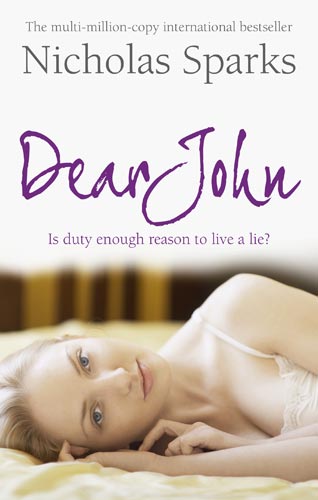
Dear John: By Nicholas Sparks: A Review


Dear John: By Nicholas Sparks


          Anyone who would have read this book would definitely rate it as a Love story but to me what aspect that was more appealing was the relationship of Father-Son that has been projected in the book.
Besides 'Dear John', I have also read 'A walk to remember' of Nicholas Sparks and anyone with a decent enough sense of observationwould note the basic two similarities in his books - The father & son relationship: which is always portrayed as faulty initially and then through a series of steps of getting to know each other a little bit better, which of course is always a silent affair but with immense efforts mustered in, leaves the reader in tears simply just to watch the whole journey of reaching simplicity from the complexities. 

The second thing would be his respect for women that is evident from his choice of characters. The lady characters in both these books are as compliant and as virtuous as they possibly can be imagined which at times seems less genuine to be true, but nevertheless expresses the view of the author of women in general which is definitely flattering to know :)
The Love story in the book is pretty much predictable but the journey of experiencing it is definitely what one should go through by reading it because well to be honest most of our classic epical Love stories are the ones which can be predicted from the cover to the end like, on top of my mind - Eric Segal's  A love story.


But its definitely not the only thing this book is all about. From the start its very prominent that the author wishes the readers to connect to 'John Tyree' (the main character) and the relationship with his father. John's father as even as he remembered him from his childhood has been an enthusiast for Coin collecting which he in-fact inherited from his father. But John is different, he is not that interested in Coins as his father, and it simulates all kind of resentful feelings in him when he becomes a teenager, like Why does his father has nothing to talk about but coins? or maybe he just feels distinct by not sharing the same passion as his father. What he fails to notice is that his father has 'Asperger's', which has been the reason through out of his behavior, his strict time-table, his lack of social desire, and the limited-topic conversations that they shared.


Its definitely a stirring sentimental story, one which definitely deserves tears at certain moments in the story. Other than that its also a matured love story facing the complications of long-distance relationship as John is a soldier in the 'infantry' of the army. It becomes monumental from mundane, when John getsenlisted for the 'war' after the 9/11 event. The author leaves the details of the war to a minimum, exempting the book from becoming a war-novel to a normal love story with a background of war to reason for the various situations that arise in the story, which is a bit unsettling and unauthentic. 


But its definitely worth a read, mostly for the first part and it implies a lot more in the simplicity with which it has been written.


Sunday, January 30, 2011

Nick & Norah's Infinite Playlist - by Rachel Cohn and David Levithan


        Nick & Norah's Infinite Playlist


                      "Life fails. Songs don't always." 

        We anchor memories to music without even trying. Certain songs drive us out of the current moment to another time and place; sometimes for good, sometimes… not-so-good. But it's rare when we're conscious enough to pay attention and see each moment as a note, each event as a song, each connection with another person as a soundtrack. And if we're lucky, something --- or someone --- forces us to tune in and know when it's time to jam along with where the music is taking us.


        In NICK & NORAH'S INFINITE PLAYLIST, Rachel Cohn and David Levithan introduce us to Nick O'Leary and Norah Silverberg, two teens whose lives revolve around music to such an extent that it becomes the compass that guides their direction. Nick, the straight bass player in a as stated in the book " a queercore band" and Norah, the straight-edged, ambiguously neurotic daughter of a music industry executive. 
And then starts a full-on saturday naught adventure full of concerts and of course the music that fits on every moment.
"Everyone in this room is connected, except Norah - she’s the kind of statue they don’t ever make, a statue of someone totally defeated".

The first thing that I liked about the book was that it is told by the prospective of both- Nick with introspection and optimism and a Norah who juggles self-doubt and unyielding confidence with a precision.

And the second thing - "the language of music" that follows around, stating the various events with a song to justify and overall ending up with a great playlist.
But, sadly that's about it. There's really no great moment in the book and nothing that would make me read it again, but I would certainly like to try the playlist involved.


Conclusion: NICK & NORAH'S INFINITE PLAYLIST lays down a beat that drives you from cover to cover and invites you to pay attention to the soundtrack that envelops your own life: it's the best way to tell who's there to sing back-up and who's up for a duet

Tuesday, January 25, 2011

The Ingenious Sarcastic Doctor Strikes Again! But This Time As An Author


The Gun Seller :
Tout Est Sous Contrôle: 
By Hugh Laurie


God and the doctor we like adore' 
But only when in danger, not before"  - JOHN OWEN


First and foremost I would like to point out that I am a big fan of Hugh Laurie mostly because of his character of 'Gregory House' the deadly sarcastic ingenious Dean of the diagnostic medicines. So I had HUGE expectations when I came to know about his first novel - "The Gun Seller". And to say I have genuinely enjoyed every moment of reading it would not be over-board by any chance.

A Little about the Author:

   Well to be frank I don't know about you butpersonally I always want the celebrities who I admire for their roles to be most likely, if not exactly, to be like the character they portray on screen. But usually that ends up as a disappointed, but definitely not in this case and m not saying this because I have read any of the Biographical files on Hugh Laurie or watched his every interview. I can say this because I have indulged myself completely from page to page in the 368 pages of his first novella and now I am really sure of the fact that the man behind all the wits and sardonicism of House is really in fact Hugh Laurie. Not only the sarcasm part but all the other extra ordinary talents of House that we fancy are also a gift from Laurie himself, which includes his love for motorbikes and his talent for guitar and keyboard. He plays guitar and keyboard in a band called Poor White Trash and he rides a Triumph Bonneville, which is a fancy swanky motorcycle. Also he realized in his college years that he has a condition called mononucleosis, which is as close to 'Gregory House' as possible.
The Book:


Anything to say about the plot of the book would actually be a spoiler because no guesswork of any kind keeps up with the story of 'The Gun Seller'. Though it has been claimed to be a 'spoof in the spy genre' in a lot of reviews but it really appears more than that to me. The spoof part can actually be mistaken because of the humor and sarcasm that can be seen in every dialogue of the main character in fact in his thinking process too. In fact A spoof is a study in absurdity, a parody of an otherwise serious topic, whereas this book tells a very real and sometimes harrowing tale from the perspective of a man with a sharp tongue and a wicked sense of humor, which is our main character Thomas Lang.
The protagonist 'Thomas Lang' is definitely a signification of what Laurie himself fancies himself to do. Some of the things are taken from his life itself, major being the love for motorbike riding and of course the witty sarcasm. Others just seem his fancy -like being in military, being a spy, the CIA operations etc. It undoubtedly seems like Hugh Laurie is writing an acting part that he would love-to-play. At every point you can see a bit of House which means a bit of Hugh Laurie in Thomas Lang, and which is what makes the story all the more interesting.
"We strolled on a bit. A pigeon flew towards us and then darted away at the last moment, as if he had suddenly realised we weren't who he thought we were."


Thomas Lang is one such character who never leaves his humor and sarcasm even in situations where people can hardly get themselves to think, let alone talk. And thats what makes him my favorite character.The sheer quantity of laughs in the book were astonishing and I honestly I lost count in the first few pages itself. From the very start of the book where he goes on about the finer points of arm-breaking, though a very serious situation it leaves you laughing out loud. And then the laughs continue with his sassy comments and his inner theories on whether 'It should be a day-break or night-fall'!! that too in the most grievous of situations is out and out hilarious.
He's rude. He's cynical. He's acid. But it's his spiciness which has made the ratings go through the roof.


 "Well, exactly. Of course. The right thing to do, the only thing to do, is to get it over with as quickly as possible.
 Break the arm, ply the brandy, be a good citizen. Their can be no other answer.
Unless.
Unless unless unless.
What if you were to hate the person on the other end of the arm? I mean really, really hate them?
This was a thing I had to consider.
I say now, meaning then, meaning the moment I am describing; the moment fractionally, oh so bloody fractionally, before my wrist reached the back of my neck and my left humerus broke into at least two, very possibly more, floppily joined-together pieces.
The arm we’ve been discussing, you see, is mine.
It's not an abstract, philosophers arm. The bone, the skin, the hairs, the small white scar on the point of the elbow, won from the corner of a storage heater at Gateshill Primary School - they all belong to me. And now is the moment when I must consider the possibility that the man standing behind me, gripping my wrist and driving it up my spine with an almost sexual degree of care, hates me. 
I mean, really, really hates me.
He is taking for ever."


"The only good thing I've ever noticed about money, the only positive aspect of an otherwise pretty vulgar commodity, is that you can use it to buy things."

The outlines of the plot are - Thomas Lang, a retired Scot guard who now freelances for classified to-hire jobs, gets an offer to assassinate an American industrialist which he indignantly refuses. Also being the all so good-natured chap that he is (not really!) he goes ahead to warn the victim of the danger that surrounds him, which lands him in a wild plot involving undercover work for the British government, notorious arms dealer, renegade CIA bigwigs, and a prototype for a military helicopter and is forced to infiltrate a small terrorist cell to protect the American's daughter. Though it sounds like your regular garden-variety Spy or James Bond sort of novel, it definitely outbids them due to the striking dark humor and surprising twists and turns.

"And as a colour-matching accessory to the shirt, she wore a Walther TPH .22 automatic in her right hand. It's utterly useless as a firearm, because unless you can guarantee hitting either the heart or the brain first time, you're only going to annoy the person you're shooting at."
I liked the plot, it was interesting but a bit of a drag at times due to all the CIA jargon. 
"It was the sheer variety of the pain that stopped me from crying out. It came from so many places, spoke so many languages, wore so many dazzling varieties of ethnic costume, that for a full fifteen seconds I could only hang my jaw in amazement. "

Also, there were sudden jumps in the narration from events which keeps a reader involved as to 'What-did-I-miss' kind of situations, because it's the petty details which Laurie doesn't bother to explain, another reason why it is interesting, because really getting into those details would have just served the purpose of making it a long and well explained novel, which now is a mysterious and to-the-point sassy one. Overall The book is laced with black humor and If you like Dr House you'll love The Gun Seller.

"Of course, I knew that Bob wasn't exactly a choirboy. He wasn't even the boy who bullies the choirboy. At the very best, he was the older brother of the boy who bullies the boy who bullies the choirboy."
        My personal reasons for liking it are - First and foremost Hugh Laurie of course, He is the writer who can deliver the funny not just type it out.  The British who can make us all think he's American and then upon learning we've been fooled we're that much more in love with him because 'we couldn't even tell.'  He says and does all those things which makes us feel a little guilty to even think about the person in front of us, which is what makes him all the more bold heroic version of sarcasm and sardonicism.

"You see, people who work in offices believe in files. Files are important to them. If you tell them you have a file, they want to believe it, because they set a lot of store by files. "
The other reason being very minor yet significant is the use of "Quotes" before each chapter which are funny verses or quotes by people which in general might not mean anything but when related to the story they are outright hilarious. It actually serves like the cherry at the top of a desert for me. 
"There is no sin except stupidity." - OSCAR WILDE


In summary I think this book is in the must-read category for anyone with a taste for classic British humor and suspenseful, thought-provoking tales. It is well written and explores the officially sanctioned yet darker side of the international arms trade as well as some of the less pleasant aspects of the human condition. 

"It wasn't caused by money, or bought with money. It simply was money. Money that he had eaten, worn, driven, breathed, in such quantities, and for so long, that it had started to secrete from the pores of his skin. You may not think this possible, but money had actually made him beautiful."

Wednesday, January 19, 2011

The Usual Sisterhood Of The Unusual Traveling Pants

 The Sisterhood Of Traveling Pants 
&
 The Second Summer Of Sisterhood:  
          -by Ann Brashares 

"Before you criticize someone, you should walk a mile in their shoes. That way when you criticize them, you are a mile away from them, and you have their shoes ;) " -  Frieda Norris


"There are tragedies in life- one is not to get your heart's desire and another is to get it"       - George Bernard Shaw
Well this would definitely be rated as one of those times when the movie lived more to the expectations than the book, in short the movie was better than the book. I was lucky enough to watch the movie first and that encouraged me to go through the books as well. 

"Men occasionally stumble over the truth, but most of them pick themselves up and hurry off as if nothing has happened"  - Winston churchill

"Of the thirty six ways of avoiding disasters, running away is the best! " - Anonymous 
'The Sisterhood Of Traveling Pants' goes completely as its name suggests towards a series of intimate friends and the adventures they embark upon with a pair of pants that plays the most significant role of binding them through some made-up rituals of passing them among them and is supposed to be magical. It starts when those pair of pants somehow magically fits all four of them, which to be honest actually appears a lame start and a lame reason for passing the pants among them and all the more stupid reason to believe that there can be magic in them.
      
    I mean honestly who thinks in this way?? But the fact that seemed more appropriate to consider behind the Traveling pants was - they were a very close group of friends and have never been apart 'literally' since birth and this was their first summer away from each other. Somewhere the idea of spending a whole summer without each other made them wish they could have a general ground, something that will be common for them and bind them together through out this whole period, thats where the traveling pants come in. They themselves invented this idea of them being magical to give each other the satisfaction of being there with each other.

Other than that its the usual story of friendship but still different because rather than a story of where people experience things together, 'The Sisterhood…' is actually more about the individual stories of each characters with only the traveling pants and the letters they write to each other, a means to link them. 


"Life isn't fair, its just fairer than death "                   - William Goldman


n I particularly liked the character and story of 'Tibby' because it appeared more real and I could relate to her more than any other character on various levels.Her problems, her passion and her specific situation when 'Bailey' a 12 year girl suffering from 'Leukemia' ( and who is head-on sarcastic) insinuates herself in Tibby's life, and her awkward silence at times says a lot more about her character than the actual words she spoke. Other than 'Tibby' I also liked 'Bridget' and could really see some familiarity in her restlessness due the enormous energy that filled her. 


"Sometimes you need to make a mess" - Lorretta,The Rollinses Housekeeper

"Fear is that little dark room where negatives are developed" - Michael        Pritchard

"Wish for what you want, Work for what you need"                    - Carmen's Grandmother

"Nothing takes the taste out of peanut butter quite like unrequited love" - Charlie Brown


"My karma ran over my Dogma" -Bumper Sticker :P
             The most interesting part of the whole series are the 'amazing quotes' that have been placed there before each chapter. They are funny, enlightening, and always gives you a short summary of the whole scenario in just a line, most of the times with metaphors (which m absolutely fond of). The thing which I found hilarious about them was that - obviously there are quotes from famous personalities but there are also quotes from the most insignificant characters in the book, giving a more funny edge to their characters and at times quotes from the main characters too which states their situation from their own point of view. It really was for the sake of these quotes that I wanted to reach to the next chapter as soon as possible because there were times when the story usually just dragged along.   
 Finally, to conclude - there are definitely things in the book that are interesting but its not really a different book in any way, even with the enormous efforts of making it strike as one. If I were to rate it, I would just give it two and a half stars and even those would be just because of the 'Quotes' and tibby's character.
Too bad I really planned on going through the entire series.

"What you do speaks so loudly that I cannot hear what you say" - Ralph Waldo Emerson

Tuesday, December 28, 2010

The Labyrinth of a great read: Looking for Alaska by John Green-bibi

         "How will I ever get out of this labyrinth!"
-Last words of 'Simon Bolivar' in Gabriel Garcia Marquez's 'The General in His Labyrinth'


I finished this one in a road trip of about 4 hours and a half and to say that those four hours have been more enlightening than anything I have ever known about religion and suffering would be an understatement. Let me tell you something about me, if given a non-fiction book about spiritualism and all that philosophical theories, I would definitely not even think about reading it but the thing is if you present it under covers, concealing it with a brilliant story and then speculate its each event, to come to a conclusion which is by all means, can lead to nothing but a logical philosophical explanation to it. I would love it. In fact anyone would love it because everyone wants to understand these things but in a way that would interest them the most, i.e with references to characters they feel familiar with rather than a jumble of intricate statements.

"So I walked back to my room and collapsed on the bottom bunk, thinking that if people were rain, I was drizzle and she was a hurricane."                                                                                                     
 "I am going to take this bucket of water and pour it on the flames of hell, and then I am going to use this torch to burn down the gates of paradise so that people will not love God for want of heaven or fear of hell,            but  because He is God.


'Looking For Alaska' is after a character named 'Alaska' (yes after the largest state in U.S). Although the story is narrated by 'Miles Halter' aka 'Pudge' ,the main protagonist who has an interesting but slightly morbid habit of memorizing the last words of famous historians. The story starts with Miles telling his parents the reason he wants to go to 'Culver Creek' a private school is to seek the great which he explains to them by showing them the Biography of 'Francois Rabelais',a poet whose last words were 'I go to seek a Great Perhaps.' And then he is off to Culver Creek where he meets his room-mate 'Chip Martin' aka 'colonel' and 'Alaska'. 


"I wanted to be one of those people who have streaks to maintain, who scorch the ground with their intensity. But for now, at least I knew such people, and they needed me, just like comets need tails." 


And then and there starts a distorted and variant image of the 'great perhaps' he had in his mind, following routine classes with regular smoking and booze, sneaking out after curfew and then at times getting busted for the same. Pudge who is in fact a 16 year old skinny, nerdy guy, he is friendless, lonely, and his greatest quirk is to read biographies in search of last words. He meets 'Alaska' courtesy to his friendship with Colonel. She is wild, funny, intelligent, moody, spontaneous, drop-dead gorgeous ,a mystery and an unattainable girl with whom Pudge instantly falls in love with. Alaska also has a reputation for smart and stylized never failing pranks. And besides everything the thing that I like most about Alaska is that like most pained and troubled people she is dead-pan sarcastic. Her pain is evident in her statements like-  "Y'all smoke to enjoy it. I smoke to die."'
  Though she is definitely not an angel of virtues and the author or narrator never even portrays her as one. She is definitely a character one comes to think the most about in the end.

Another of my favorite characters in the book is Chip 'colonel' martin, who reminds me a bit of  'Fred & George ' i.e the weasely twins in the Harry Potter series. He is smart and also sarcastic to the core and values the things that value most in life - his integrity which is the reason behind why he never rats and his friends. His tales of getting evicted out of the gym due to the nuisance he creates are hilarious. 


"I mean, it's stupid to miss someone you didn't even get along with. But, I don't know, it was nice,
you know, having someone you could always fight with."  - Colonel
But the story is not about Colonel or Alaska neither is she the main character, definitely a very important and unforgettable one but not the main, the story is about derivations of meaning of life, suffering, guilt, friendship and other values higher than life itself. The centre of the story is around a discussion about the 'labyrinth' from the last words of Simon Bolivar. 


Alaska: "'He'—that's Simon Bolivar—*was shaken by the overwhelming revelation that the headlong race between his misfortunes and his dreams was at that moment reaching the finish line. The rest was darkness. "Damn it," he
sighed. "How will I ever get out of this  labyrinth!'" (those were his last words)
Miles: "So what's the labyrinth?"
Alaska: "That's the mystery, isn't it? Is the labyrinth living or dying? Which is he trying to escape—the world or the end of it?" 
The second half of the book takes this discussion to yet another level where to finally as Alaska concludes the labyrinth symbolizes 'suffering' and the ways of getting out of it varies according to the person. 

        "The only way out of the labyrinth of  suffering is to forgive."                                                                                                   
The whole book is divided into two parts which I can't really explain at all without giving away the most intimate essence of the book itself. The narrator classifies the parts as a 'before' and 'after' of a certain event, and that certain event is the death of Alaska Young in a car accident. He uses terms like " one hundred eight days before" and " hundred and nineteen days after" .But its really the second half of the
book where it becomes from mundane to momentous. The demise of Alaska comes as a shock to Miles and Colonel and they both blame themselves for letting her go and drive that drunk that night but the later turn of events makes them susceptible to the possibility that Alaska might have committed suicide. Owing to her memory they try to investigate whether her death was an unavoidable fate or willful self-destruction.

"I may die young, but at least I'll die smart." 

There are many layers to Alaska's character and one finds very little time to explore it which adds to the mystery that already Alaska is. Like Miles (pudge) himself admits of having so little time to know Alaska and not being so sure of whether he even knew her well.


 Things that did not go right, things that seemed okay at the time because we could not see the future. If only we could see the endless string of Consequences that result from our smallest actions. But we can't know better until knowing better is useless.

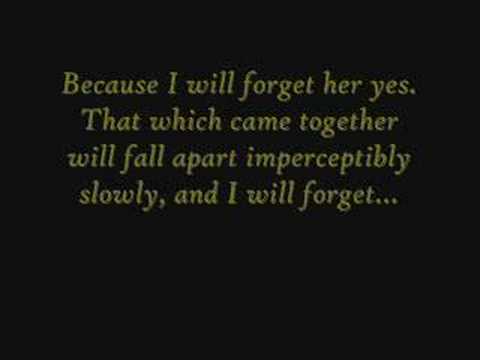
Through out the second half the narrator makes various speculations on life and discovers the truth of life on different aspects. He even admits to the fact that even though he was in love with Alaska, he will forget her, her memory will fade like everything falls apart, which was definitely very blunt and brave. The final paper that he presents where he answers to the question of " how will one get out the labyrinth of suffering" is definitely something that I will never forget because it presents us a picture of the whole reality and circle of life in a few pages.
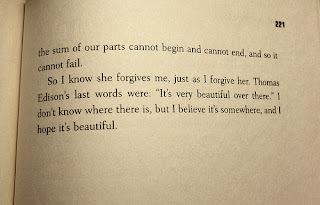
Overall I found the book definitely climbing its way to my favorites and I still can't believe that this is John Green's First novel!! I am definitely looking forward to more of his work now. 'Looking for Alaska' is a mirror to the various aspects of human life and the philosophy behind it entwined with a story that is lively and yet ironically painful and still full of hopes. In my opinion, it's this combination and the characters that make this book a masterpiece!!


 "When adults say, "Teenagers think they are invincible" with that sly, stupid smile on their faces, they don't know how right they are. We need never be hopeless, because we can never be irreparably broken. We think that we are invincible because we are. We cannot be born, and we cannot die. Like all energy, we can only change shapes and sizes and manifestations. They forget that when they get old. They get scared of losing and failing. But that part of us greater than the sum of our parts cannot begin and cannot end, and so it cannot fail." 
— John Green (Looking for Alaska)