Wednesday, November 10, 2010

Boarding Hogwarts Express Once Again: Harry Potter And The Goblet Of Fire – By J.K Rowling


             When it comes to a completely well framed, humorous and addictive imagination, J.K Rowling never disappoints. No matter how many times I read the Potter series, its always amazing to find myself glued irresistibly to the book till I finish it and this in my opinion counts as one of the most important characteristic of a favourite book as well as a favourite author, which is to make the the book as fun as possible to read even the umpteenth time as it was the first time I laid my hands on it. And most of the Potter series are definitely under that category.

About The Goblet Of Fire:

Unlike the first and second book which was mostly an introduction to the wizard world and and where our main characters were just kids entering school, this book features their advanced stage of adulthood which I found rather interesting. Also the challenges they face are much more dangerous and even the way they talk to each other and the way they think reflects their maturity and also Harry's familiarity with the wizard world. Its strange but when reading this book after reading the first two, yo find yourself growing with Harry in terms of the knowledge about the Wizard world, because we know exactly the same amount as  he does.


J.K. Rowling definitely has a knack for creating mystery. the way she started the book with total air of mystery about “The Riddle Family” and their murders is really appreciable. Also I find the way she links the story really fascinating, even after one's done with the book it takes up most of my time thinking the links in the book and the reasons she must have had behind them.


Other than that the book is full of hilarious moments – 
  • One for Percy's absolute dedication for work and Fred & George's complete ridicule at him for the same.
  • Mr. Couch calling Percy “weatherby” 
  • An excerpt for the point above- 

Percy, apologizing most profusely, said that he really needed to get to work.
"I just can't justify taking more time off at the moment," he told them. "Mr. Crouch is really starting to rely on me."
"Yeah, you know what, Percy?" said George seriously. "I reckon he'll know your name soon."

            Traces of Rowling's amazing sense of humour can be seen every where in the book, weather it be the innovative study sessions of Harry and Ron where they invent a series of catastrophes that they predict they are eventually going to end up in for an assignment for their Professor Trelawney of Divination or their seriousness for Snape's lessons when he claims he is going to poison them to check whether the anecdote they have prepared is correct is not. (and knowing Snape's reputation, its really a hilariously serious and funny situation at the same time).

Another funny quote featuring Percy weasley again ;) -  

“Percy wouldn't recognize a joke if it danced naked naked in front of him wearing Dobby's tea cozy”  
– Ron weasley                                       


Another thing I've always admired in the Potter series is the completely weird syllabus book names that you came across while reading like -
  • Where There's a 'Wand' There's A Way.
  • Madcap Magic for Wacky Warlocks.
  • Men Who Love Dragons Too Much.
  • Fantastic Beasts And Where To Find Them.
  • Power You Never Knew You Had And What To Do With Them Now You've Wised Up.

                    ________

  The main highlights in the book the book was how Harry who was underage got into Triwizard tournament without his own will as a plot by voldemort and how he tackles the three tasks of the tournament which are held over a gap over certain months over the year. the whole story revolves around how he manages to get through and when he finally reaches the end of the third task which was a maze to reach the triwizard cup along with Cedric Diggory, it turns out to be a portkey and transfers him directly to a graveyard where Peter Petrigrew uses Harry to bring back voldemort which changes the entire scenario and leaves Cedric Diggory dead.


The death of Cedric Diggory was definitely a shock and was certainly unexpected. In fact the whole scene of bringing voldemort back to living form was spooky enough to raise goose-bumps. And it completely changed the way the story was leading on. Another important twist comes in next when the Minister of Magic refuses to believe Voldemort is back but no one can realize the importance of that until the next part ........

Tuesday, November 9, 2010

Hogwarts's Additional treats : Fantastic beats & Quidditich


Fantastic Beasts & Where  To Find Them
                                     - By Newt  Scamander
&
                Quidditich Through The Ages

    - By Kennilworthy Whisp


First of all before any of us make any assumptions about merchandising, I must make this very clear that both of these books. are written by J.K Rowling for a charity called Comic Relief UK .

                                                                      About Comic Relief:
  Comic Relief is one of Britain’s most famous and successful charities which began  in 1985. The Harry Potter books
represent a new opportunity in Comic Relief’s quest to make a meaningful difference in people’s lives. A special Harry’s Books fund has been created where twenty percent of the retail sales price less taxes from the sale of 'Quidditch Through the Ages ' and 'Fantastic Beasts & Where to Find Them' will go to support children’s causes throughout the world.

Apart from this the notes written on 'Fantastic Beasts...' which is a textbook at Hogwarts  by Harry and Ron are funny enough. Although I found the 'Quidditich through...' a bit boring but my lack of interest  in sports might justify that. Though the reason for the publication of these books and the fine details with which they have been printed is really appreciable and is therefore worth a good read :)

Also there are foreword notes from Dumbledore who expresses his views on these books being distributed among muggles and reluctance of Madam Pince (Librarian at Hogwarts) who is speechless at this piece of information and reluctantly agreed to hand over the book.

Then theres also a mention of 'A thief curse' which in muggle terms has been placed on the books to prevent piracy.


Note: You might have noticed I refer muggle world as separate that is because I don't count myself as a part of it. I prefer Rowling's version of the wizard world than the muggle one ;) 

Monday, November 8, 2010

The Tales Of Beedle The Bard - By J.K Rowling

    
              Truth - “It is a beautiful and terrible thing, and should therefore be treated with great caution.”
             - Professor Albus Dumbledore


 The Tales of Beedle the Bard is a collection of short stories by J K Rowling which are meant to be ancient wizard world tales for the young wizards written originally in Runes and translated by Hermione Granger with additional notes from Prof. Albus Dumbledore which he left in his will to The Hogwarts Archives.


         I would definitely say I thoroughly enjoyed reading the ancient tales of the wizarding world, because when you read our simple fairy tales, which of course when involves no magic at all, always leaves the main character helpless initially, then with some help and courage, the character reaches to the stage of maximum satisfaction and lives happily ever after.


 But here in the wizarding world where every character is capable of conjuring before themselves anything they might want to make life easier for them it really seems hard to imagine them getting into trouble and getting out of it. And this is what these stories were mainly focused on, that - “Magic is not everything”. There are many limitations to magic which little children (wizards of course) learn through these stories, a lesson which of course can be helpful to a lot of elders and other muggles too.


    At the end of each story there are notes from Prof. Albus Dumbledore himself which include observations on wizarding history, personal reminiscences and enlightening information on key elements of each story, which was personally the most interesting and entertaining part of the whole book for me. Because obviously they are Dumbledore's view and no matter how twisted they might be at times to understand they are still absolutely enlightening and amazing. Another fact that might add value to it is that Dumbledore is always potrayed with an air of mystery in the Harry Potter series and to know his views with absolute clarity on the basic issues of the wizarding world in his own words would be a privilege for anyone.


               Certain stories also describe a bond between the wizarding world and the muggle world which of course is a good thing but as later described by Dumbledore has been criticized by certain so-called “pure-blood” wizards, who have made efforts to either modify or remove such stories from the book, my point in bringing this up is the “ battle” phase that we see constantly between Harry Potter and Draco Malfoy is the effect of the history that follows due to the thinking of certain narrow minded wizards which has been transferred in their heritage and due to that the war is still on.....

Wednesday, October 20, 2010

'Twenties Girl' : by Sophie Kinsella

This definitely isn't Sophie Kinsella's best, and it took me a while to get into it. Sophie Kinsella's books are known to be fun and filled with ridiculosity, but this one took it to another level. 


About 'Twenties Girl', I would say, a well linked and well versed story-piece which explores human relationships. Though there was certainly a lack of typical author's humour missing in this book also but it was well made up by the extensiveness of the story or rather how it appeals to oneself.


In Twenties Girl, Lara Lington attends the funeral of her 105-year-old great-aunt, Sadie Lancaster, whom she never knew. Then all of a sudden, Sadie's ghost, at the age of 23-years-old, appears to Lara. Lara is the only one who can hear or see Sadie. Sadie begs Lara to stop the funeral and to help her find her dragonfly necklace. 


I initially thought the storyline of the ghost bothering Lara was annoying and too ridiculous. I also didn't think it was very original since I've read/watched other stories involving a ghost that only certain people can see. If this book hadn't been written by Sophie Kinsella, I may not have even finished it.


But THEN, it started to get more interesting and Lara became involved in many funny and typical of Kinsella scenarios. Sadie was also an interesting character and the mischief the two engage in is hilarious. There is also a side plot that I realized later into the reading and it all came together in the end and wrapped up well. I grew to really like the two characters. There were moments when I laughed out loud and other heartwarming moments, as I mentioned earlier.


While, I wouldn't necessarily recommend this book as one of the first of Kinsella's to read, those who are already fans of hers will definitely find a hint of her typical humor and fun in this  novel!


For a 410 paged novel its definitely one that can keep you hang on to it long enough for your interest in it, even you quite don't exactly reach that level of appreciation in the end, you still find your time worth while.

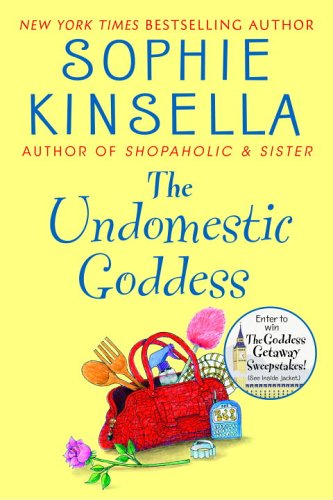
'The Undomestic Goddess' by Sophie Kensella


                 Sophie Kinsella is my favorite chick-lit author. I enjoy her books a lot for their fun factor. And after reading a lot of serious but rewarding books lately, I needed to laugh while still enjoying the experience. Really laugh, as in rolling-on-the-floor laughing! 


The humor in The Undomestic Goddess was quite tickling. Not always, but mostly. It started with Samantha sitting in a spa, to use a gift voucher that she got on her birthday the previous year. She is a highly busy lawyer, with a non-existent social life, hoping to become the youngest partner in her firm. There, we get a rib-tickling insight into her stressed life and obsessive preoccupation with her work. Her work is scheduled at 6 minute-phases. Her daily routine would look like this: 

11:00-11.06  drafted contract for Project A

11.06-11.12  amended documentation for Client B

11.12-11.18  consulted on point for Agreement C


One day, when she makes a costly error, of the value of 50 million pounds, she loses her job and almost in a trance, gets herself employed as a housekeeper. Samantha Sweeting - who couldn't cook to even save her life, or even take care of her own apartment - was suddenly in charge of looking after a mansion and its two owners. What follows is a hilarious follow-up of her transformation! I liked Samantha Sweeting the best of the Sophie Kinsella heroines so far, because for a change, here is a woman who is not obsessed with make-up or clothes and shoes, or any of the things that fascinate most women in fluff chick-lit books. While I wish she had some "me" time, she was still a smart woman who got things done. Even when she tries to resign from the housekeeper job, she does it so diplomatically that the owners offer her a raise. Initially, she even tried applying her principles from her job to housekeeping, starting with a schedule. 


9:30-9.36 Make Geiger's bed

9.36-9.42 Take laundry out of machine and put in dryer

9.42-10.00 Clean bathrooms

Needless to say, the result is hilarious! 


As with other Sophie Kinsella reads, this one is also predictable, and that's about the only other thing I have to complain about. Although  I would have loved some more unpredictability thrown into the ending. In a real world, I find what Samantha did in the ending to be extreme and personally I don't quite agree with it.


But then most of the Sophie Kinsella books have heroines who probably wouldn't exist in the real world, such as Lara Lington of Twenties Girl, who could talk to the ghost of her great aunt, Rebecca Bloomwood of Confessions of a Shopaholic, who is very deep in debt and still can't put a stop to her buying behavior.


Overall : Good, but I still find the Becky humor of Shopaholic series lacking....

Monday, October 11, 2010

To Kill a Mockingbird by Harper Lee

Have you ever noticed how children book's or literature actually teaches us more lessons than probably any other experiences we might have. For example - In the book "To kill a mockingbird" - the narrator is a little girl who has been reading ever since she was born and the way she thinks is depicted through out the narration. Its amazing how a kid who does not even know the meaning of half the swear words that she uses at times teaches us how inncocent childhood is and certainly if we think of our big problems from the point of view of such little kids not only they seem easy but also their solution seem even easier.


          The story revolves around Scout (the little girl) and her brother, motivated by a summer friend of theirs,Dill,trying to get a neighbour of theirs 'Boo Radley' aka Mr Arthur Radley out of his home . Their various plans and plots to do so. How the circumstances around them teach them a lesson about the kind of society they are in that they feel at a point of time that may be the society is such a ill-rotten place to live in that Boo Radley is satisfied without being a part of it.


              Its hilarious when Scout enters First grade and on her first day to school she is punished for being able to read. Her teacher asks her to tell her father that he has been teaching her all wrong, and that he should stop. Little Scout, so worried after her first day, that she won't be able to read anymore with her father, says to her brother very innocently, "that lady says Atticus's has been teaching me to read wrongfully, and for him to stop it".
(Atticus being the name of their father)


            Another major event in the book was the court case that Scout's dad who is a lawyer takes up in favour of a coloured man. We encounter the feelings of the kids of the lawyer when the whole county turns against him and blames him for bringing them shame for favouring a Black. The feelings that rise in the children by observing rascism around them,and that too fought by their own father,are described with complete innocence the narration of Scout. To Kill a Mockingbird portrays a society that is supremely, staggeringly unfair: the U.S. South in the 1930s in a small town where racism is part of the very fabric of society.

           Some people in the novel do just sit still. But a few decide to do what they can to take action on the side of justice and equality, even though they think it’s mostly hopeless. To Kill a Mockingbird doesn’t sugarcoat the results (minor spoiler: the book does not end with African-Americans and whites holding hands and singing. It does, however, suggest that doing something to make life a little more fair, even if it seems like it’s not having any effect, is still worthwhile, and what’s more, admirable.


           Through out the book their have been major issues seen by minor eyes as witnesses and described to us as daily events that really ought to appeal to how much we miss by being a grown-up.

Wednesday, September 29, 2010

Catcher In The Rye : By J.D Salinger


'The mark of the immature man is that he wants to die nobly 
for a cause, while the mark of the mature man is that he wants to live humbly for one.' - Wilhelm Stekel


There are times in every one's life where one could relate to 'Holden Caulfield', the main character and the narrator in the book. Though through his point of view one can see the how the world which is so progressively supposed to be dependent on elite and full of ivy league people is actually composed of nothing but mere phonies which is what Holden repeatedly refers to them as, which surprisingly never seems incorrect. The book is full of very emotional moments experienced by Holden.
    
The narrator tells us about his experience after being kicked out from a reputed school, though he is a brilliant student, he is just not interested. He is frustrated with the people around him and their phony behavior. He is sick of people being fake to each other. For him the idea of the basic society human behavior in which one person has to behave in a particular manner to other is somehow unacceptable. He is a rebel and is thus unacceptable to the society.

But what you find so adorable about him and makes you totally relate to him is the fact that deep down at some point of time we feel the same way, we feel rebellious at times, don't like the way we are supposed to be in the society, at times the way the society portraits itself to you, it just wants to makes you want to puke your guts out, this it the extent to which 'Holden' is frustrated. 

I particularly liked two parts one where he comes to his teacher Mr Antolini and he preaches him about how he is not the first person has failed and not necessarily the person who have failed in their past were failures, and also that they have kept records in the form of journals as books and poetry which are famous today from which people like him should learn and then again there's a conflict about the character of Mr. Antolini which I will leave unexplained here but was quite intriguing to me.


The most satisfactory part of the whole story was about the narrator's ten-year old sister Phoebe, because she was among the only few people the narrator really admire in the whole world and that was not because of the mere fact that she was his sister, it was because she was a kid and unlike others she was not phony and was more sensible than any person he knew.
I just loved the way the he wrote after anything he described about phoebe...."good old Phoebe, you would have liked her." :)